The Transformation
Data Strategy Roadmap for Growing Businesses
Start with business problems, not technology. Sequence for maximum return.
A data strategy is not a technology plan. It is a business plan expressed through data. It starts with the decisions your leadership team needs to make, works backwards to the data required to make those decisions, and then defines the architecture, governance, and roadmap to get there. If your data strategy starts with a tool or platform, you are solving the wrong problem first.
Start With the Business
The first question is not "what data do we have?" It is "what decisions are we making poorly, slowly, or on instinct?" Map your leadership team's most critical decisions. For each one, identify: what data would make this decision faster and more reliable? Where does that data currently live? How is it currently accessed? The gap between what you need and what you have is your data strategy. McKinsey research shows that companies in the top quartile for data-driven decision making are 5% more productive and 6% more profitable1 — this is the prize a good data strategy unlocks.
5–6%
Productivity and profitability gains for top-quartile data-driven companies
McKinsey, 2020
Data transformation is a journey, not a project. We build with our clients, not for them.
Phase 1: Foundation (Weeks 1-6)
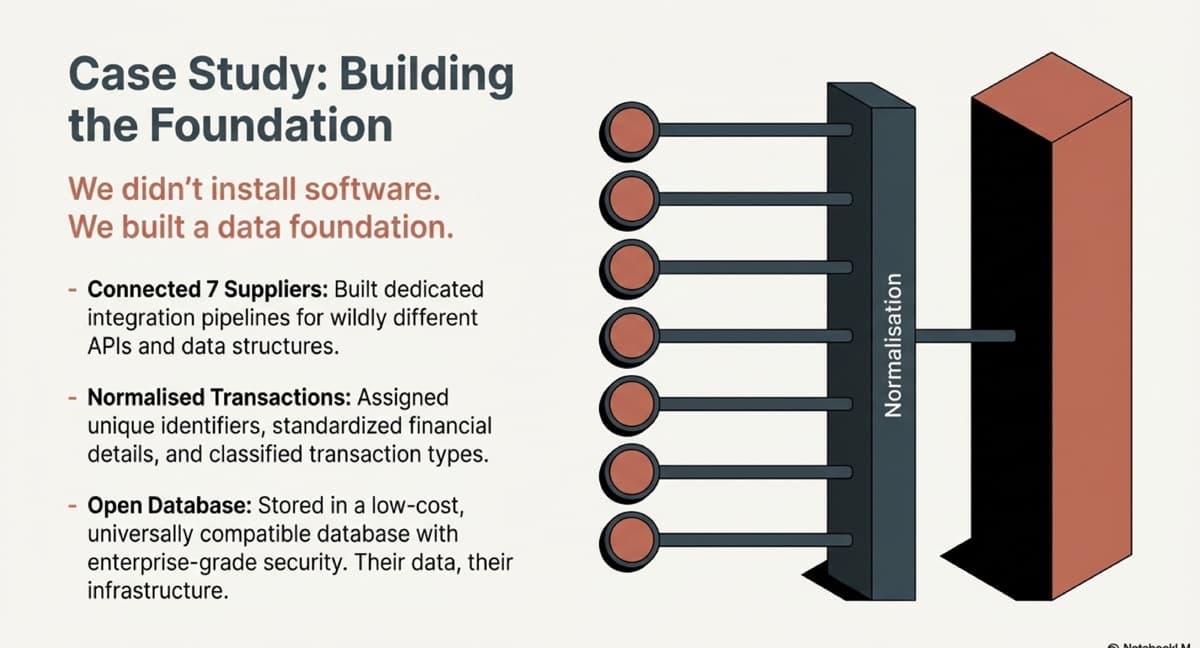
Connect your core operational systems — typically 3 to 7 platforms — into a single data layer. Normalise the data into a consistent schema. Stand up a modern, low-cost database. At the end of this phase, your critical business data lives in one place, structured consistently, refreshing automatically. This alone eliminates hours of manual reconciliation work every week.
Phase 2: Intelligence (Weeks 4-10)
Build the analytics-ready tables that power your decisions. Pre-computed metrics that refresh daily. Dashboards anchored to your commercial priorities. Automated alerts for the metrics that matter most. This phase overlaps with Phase 1 because you can start building analytics on the first systems you connect while continuing to integrate the rest. The goal is quick wins that demonstrate value while the full foundation is being built.
Phase 3: Capability (Ongoing)
With the foundation and intelligence layers in place, advanced capabilities become possible and practical. Sales forecasting. Demand prediction. Customer segmentation. Pricing optimisation. AI agents that can autonomously execute decisions based on real-time data. Forrester research shows that insights-driven businesses grow at an average of 30% annually2. Each of these capabilities would be a standalone project without a foundation. With one, they are incremental additions to an existing infrastructure.
Sequencing Matters
The most common mistake in data transformation is trying to jump to Phase 3 — the exciting AI and advanced analytics work — without doing Phases 1 and 2. This is like trying to build the penthouse before the foundation is poured. It does not work, it wastes capital, and it creates disillusionment with data initiatives that makes the next attempt harder to get funded internally.
Measuring Success
A data strategy should pay for itself. The metrics are practical: how many hours per week are saved on manual reporting? How much faster are leadership decisions? How much more accurate are forecasts? What is the cost reduction from consolidated tooling? Track these from day one. They are the evidence that justifies continued investment and the foundation for a business case that grows over time.
Sources
- McKinsey Global Institute, "The Age of Analytics" (2020)
- Forrester, "Insights-Driven Businesses Set the Pace for Global Growth" (2021)
Related Capabilities
Data Strategy & Architecture
Before any technology investment, the architecture and governance must be right. We define data strategy aligned to commercial objectives — the roadmap, standards, and operating model that turn raw data into a durable competitive asset.
Infrastructure & Database Modernisation
Legacy systems and fragmented databases slow everything down. We modernise your data infrastructure — warehousing, pipelines, and platforms — to eliminate silos, reduce cost, and establish the single source of truth your organisation can scale on.
Continue Reading
The Foundation
What Is a Data Foundation (And Why It Matters)
A data foundation is the structured, connected data layer that powers every reliable decision, dashboard, and AI capability in your business. Learn what it is and why it is the most important investment you can make.
Read →The Transformation
How to Connect Disconnected Business Systems
A practical guide to getting data out of silos and into a single place. The unglamorous, complex, but essential work that makes everything else possible.
Read →The Outcome
The Compounding Returns of Clean Data
Clean data is accretive in almost every aspect of your organisation. From faster decisions to AI readiness to increased valuation — the returns compound over time.
Read →Ready to build your data foundation?
Let's have a conversation about where you are and whether data foundations are the right investment right now.
Start a Conversation