The Foundation
What Is a Data Foundation (And Why It Matters)
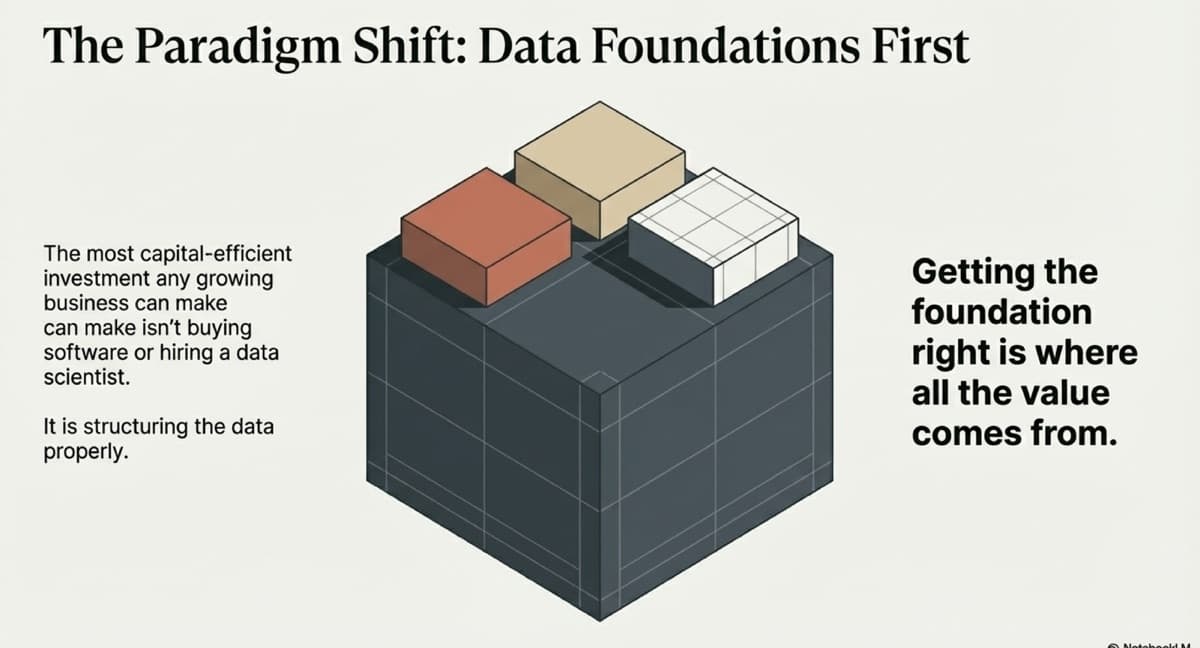
The most capital-efficient investment any growing business can make.
A data foundation is the structured, connected data layer that sits beneath every dashboard, every report, every forecast, and every AI capability in your business. It is not a product you buy. It is not a platform you subscribe to. It is the result of deliberate architectural work: connecting your systems, normalising your data into a single consistent language, and storing it in infrastructure you own and control.
What a Data Foundation Actually Looks Like
At its core, a data foundation has three layers. First, integration: getting data out of the silos where it currently lives — your CRM, your accounting system, your operations platforms, your marketing tools — and into a single place. This is unglamorous, complex, and essential work. It means negotiating APIs, building reliable pipelines, and handling the messy reality of systems that were never designed to talk to each other.
80%
of organisations scaling digital will fail without modern data governance by 2025
Gartner, 2022
Second, normalisation: creating a single, consistent language for your data. This means global best-practice data modelling. Clean tables with clear definitions down to the atomic level. When "revenue" means the same thing in every report, in every system, for every team, you eliminate an entire category of confusion that currently costs you hours every week.
Third, storage: putting your normalised data into a modern, universal database. Open-standards, low-cost, and highly scalable. You own it. No vendor lock-in. If you adopt Salesforce tomorrow or plug in a new ERP next year, the data is already structured. Implementation timelines shrink, migration risk drops, and costs come down.
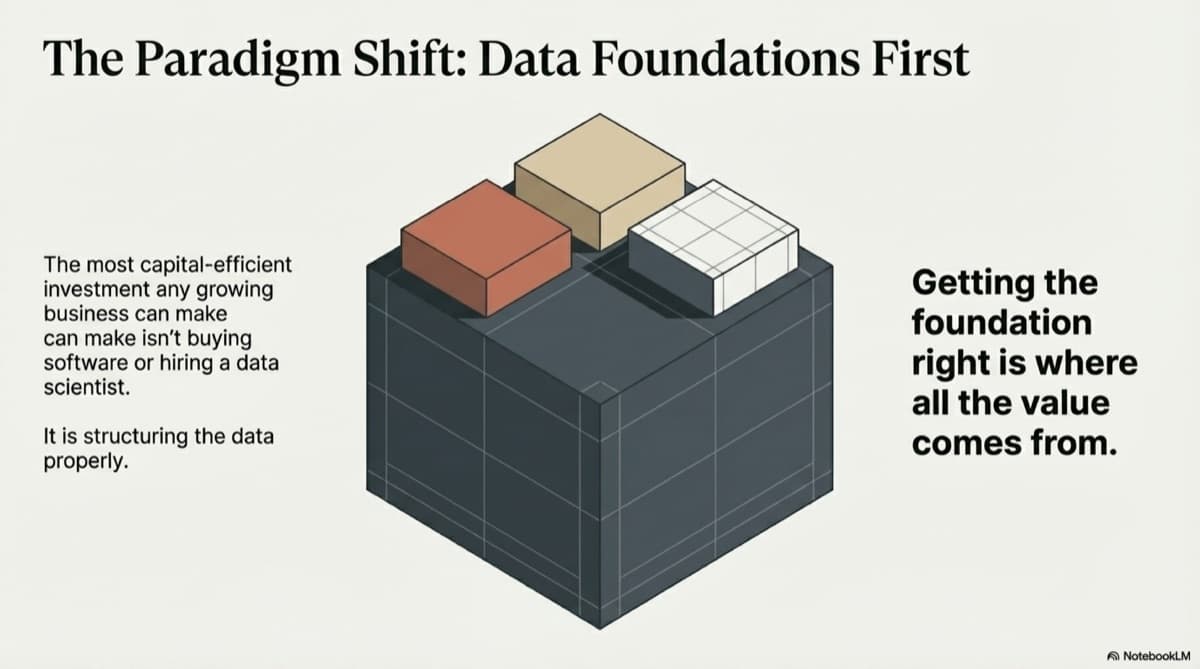
The database is the product. The applications are just interfaces.
Why It Matters More Than Software
Most businesses approach their data problem backwards. They buy a BI tool and expect it to create clarity. They invest in AI and expect it to surface insights. But no tool — no matter how sophisticated — can compensate for a broken foundation. Gartner predicts that through 2025, 80% of organisations seeking to scale digital business will fail because they lack a modern approach to data and analytics governance1. A dashboard built on inconsistent data produces inconsistent answers. An AI model trained on messy data produces unreliable predictions. The foundation is not an optional nice-to-have. It is a prerequisite for everything else.
The Portability Advantage
A properly built data foundation outlasts any individual software decision. It is built on open standards, meaning it is portable across tools, platforms, and vendors. This is strategically important: it means you are never locked in to a single vendor, and every future technology decision becomes lower-risk and lower-cost because the data layer is already structured and ready. Experian research confirms that 95% of organisations see negative business impact from poor data quality2 — a foundation eliminates this risk at the source.
Getting Started
Building a data foundation is not a multi-year, multi-million dollar enterprise programme. For most founder-led businesses with revenue between $1M and $100M, the core foundation can be built in weeks — connecting your key systems, normalising your critical data, and standing up the infrastructure that makes everything else possible. The investment is modest relative to the value it unlocks, and it compounds over time as you layer on new capabilities.
Sources
- Gartner, "Data and Analytics Governance" (2022)
- Experian, "Global Data Management Research" (2019)
Related Capabilities
Infrastructure & Database Modernisation
Legacy systems and fragmented databases slow everything down. We modernise your data infrastructure — warehousing, pipelines, and platforms — to eliminate silos, reduce cost, and establish the single source of truth your organisation can scale on.
Data Strategy & Architecture
Before any technology investment, the architecture and governance must be right. We define data strategy aligned to commercial objectives — the roadmap, standards, and operating model that turn raw data into a durable competitive asset.
Continue Reading
The Foundation
Data Foundations vs. The Big Software Purchase
When reporting breaks, the instinct is to buy new software. Here is why investing in your data foundation first is more capital-efficient and delivers better outcomes than any tool purchase.
Read →The Foundation
Single Source of Truth, Explained
What a single source of truth actually means for a growing business, how to build one, and why it eliminates the reconciliation headaches that cost you hours every week.
Read →The Transformation
How to Connect Disconnected Business Systems
A practical guide to getting data out of silos and into a single place. The unglamorous, complex, but essential work that makes everything else possible.
Read →Ready to build your data foundation?
Let's have a conversation about where you are and whether data foundations are the right investment right now.
Start a Conversation