The Outcome
How Clean Data Increases Company Valuation
Clean data is a valuation multiplier. Messy data is a discount.
When investors, acquirers, or board members evaluate a business, they ask for numbers. Revenue by segment. Customer acquisition costs. Churn rates. Margin by product line. How quickly and confidently you can produce those numbers tells them more about your business than the numbers themselves.
The Due Diligence Signal
If an investor asks for your unit economics and your answer is "give us a week," that is a red flag. It signals that your data is fragmented, your reporting is manual, and your operational visibility is limited. Every week of delay in due diligence introduces risk — and risk gets priced in. Conversely, a business that can produce reliable, granular numbers on demand signals operational maturity. The data is clean. The systems are connected. The leadership team is making decisions based on reality, not instinct.
If an investor asks for numbers and your answer is "give us a week," that is a red flag.
How Data Quality Affects Multiples
Acquirers pay for certainty. Clean, structured data provides certainty about historical performance, customer behaviour, and market dynamics. McKinsey found that companies in the top quartile for data-driven decision making are 5% more productive and 6% more profitable1. This certainty directly supports higher multiples. A business with the same revenue but better data infrastructure will consistently achieve a higher valuation — because the acquirer can model the future with greater confidence, reducing the risk premium they apply.
5–6%
Productivity and profitability gains for top-quartile data-driven companies
McKinsey, 2020
The Hidden Cost of Messy Data in M&A
In acquisition processes, data quality issues do not just reduce valuation — they kill deals entirely. Due diligence teams that discover inconsistent revenue figures, unreliable customer counts, or unreconciled financial data will either walk away or demand significant price reductions. Gartner estimates that poor data quality costs organisations an average of $12.9 million per year2. The cost of fixing these issues under time pressure is always higher than fixing them proactively. And the reputational cost of a failed deal process can take years to recover from.
Beyond Exit: The Operating Advantage
Even if you never plan to sell, the operational advantages of clean data — faster decisions, lower costs, better risk visibility — create a business that is simply worth more. It generates better returns on capital, attracts better talent (because people want to work in data-mature organisations), and compounds its advantages over time. Whether you measure value as exit multiple or as annual operating performance, clean data improves the number.
Getting Your Data Investment-Ready
If a capital event is on your horizon — within the next 12 to 36 months — the time to invest in your data foundation is now, not when due diligence begins. Building a data foundation under deal pressure is expensive, stressful, and often too late. Building it proactively gives you the operational advantages immediately while ensuring you are ready when the moment arrives.
Sources
- McKinsey Global Institute, "The Age of Analytics" (2020)
- Gartner, "How to Improve Your Data Quality" (2021)
Related Capabilities
Data Strategy & Architecture
Before any technology investment, the architecture and governance must be right. We define data strategy aligned to commercial objectives — the roadmap, standards, and operating model that turn raw data into a durable competitive asset.
Business Intelligence & Decision Systems
Executives need clarity, not dashboards for their own sake. We build reporting and decision systems anchored to your commercial priorities — replacing manual processes with real-time intelligence leadership can act on.
Continue Reading
The Outcome
The Compounding Returns of Clean Data
Clean data is accretive in almost every aspect of your organisation. From faster decisions to AI readiness to increased valuation — the returns compound over time.
Read →The Problem
What Messy Data Actually Costs Your Business
Messy data creates slow decisions, wasted hours, invisible risk, and missed opportunities. Learn the real cost of scattered, inconsistent data across your business systems.
Read →Ready to build your data foundation?
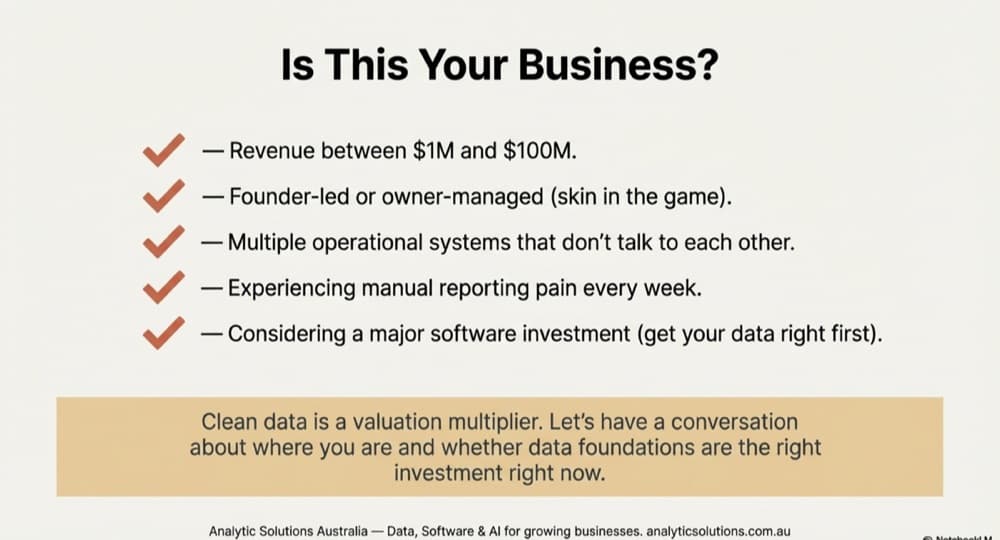
Let's have a conversation about where you are and whether data foundations are the right investment right now.
Start a Conversation